
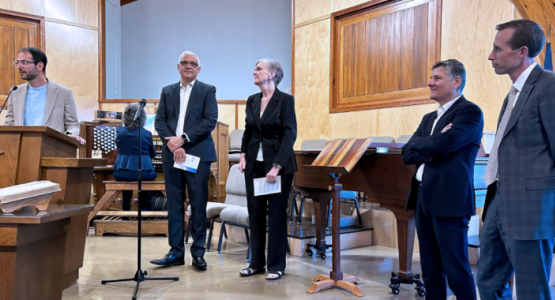
Kettering Health Chaplain Finds Calling and Community in Adventist Faith
 Story by Garrett Conti
Debi Robertson did not begin her chaplaincy career until she was 69.
After 30-plus years as a social worker, primarily serving individuals with developmental disabilities, Robertson entered the Clinical Pastoral Education program at Kettering Health in Dayton, Ohio. Today, at 74, she serves as a part-time chaplain at Kettering Health’s Hamilton campus. She just finished her Fourth Unit of training, which is equivalent to 1,600 hours of clinicals and classroom time.
“I decided that I would like to do something I’ve always wanted to do, and that’s to be a chaplain,” Robertson said.
After raising her children — two adopted children and one biological son — Robertson reached a point where she could finally pursue a long-held interest in spiritual care.
“She moved out in April, and I applied in May,” Robertson said, referring to her youngest daughter.
Robertson said her background in social work prepared her to support people through difficult circumstances, but chaplaincy required a different level of presence.
“To be a chaplain, you have to give your whole heart,” she said. “You have to give your total self, or you don’t do any good for anyone, including yourself.”
At Kettering Health, her work reflects the system’s mission to live God’s love by promoting and restoring health. She spends much of her time supporting staff, in addition to visiting patients and families.
“Kettering made it very clear from the beginning that we take care of staff first, patients second, and community third — and I love that,” Robertson said.
Her responsibilities include leading devotionals, offering prayers and supporting employees across the hospital.
You can minister to people in the grocery store,” she said. “We are all ministers, and we get to practice it every day.”
Robertson’s professional development has taken place alongside a shift in her personal faith. Raised in the Church of Christ, she spent years moving between denominations before connecting with the Seventh-day Adventist Church during her chaplaincy training.
“I saw real people, real Christians who were walking their talk,” Robertson said.
She said the Adventist emphasis on Sabbath and whole-person health aligned with her beliefs.
“Sabbath is like spending time with your dad,” she said. “You can’t wait to be together.”
After visiting an Adventist church in Hamilton, Ohio, Robertson said the decision felt clear.
“God said as I drove into the parking lot, ‘this is your home,’” she said.
Nestor Bruno, the director of Mission and Ministry at Kettering Health, said Robertson’s development reflects the goals of the system’s spiritual care program.
“Debi Robertson represents the best of what spiritual care formation can be,” Bruno said, “because it includes professional growth and personal growth — an intimate correlation between being a better care provider and growing intimately as a human being and son or daughter of God. She brings together pastoral wisdom, clinical depth and a genuine commitment to helping chaplains grow into their calling.”
Robertson said she does not view her path into chaplaincy or the Adventist faith as accidental.
“I feel like I wouldn’t be here if I hadn’t been led to Kettering and hadn’t been led to chaplaincy,” she said.
“God wanted me here.”
At Kettering Health Hamilton, located between Cincinnati and Dayton, that sense of purpose aligns with a broader mission to care for the whole person — physically, emotionally and spiritually. For Robertson, chaplaincy is not separate from her faith but an expression of it, lived out in conversations, prayers and quiet moments of presence. It is work she came to later in life, but one she approaches with clarity about where she belongs.
Add new comment